
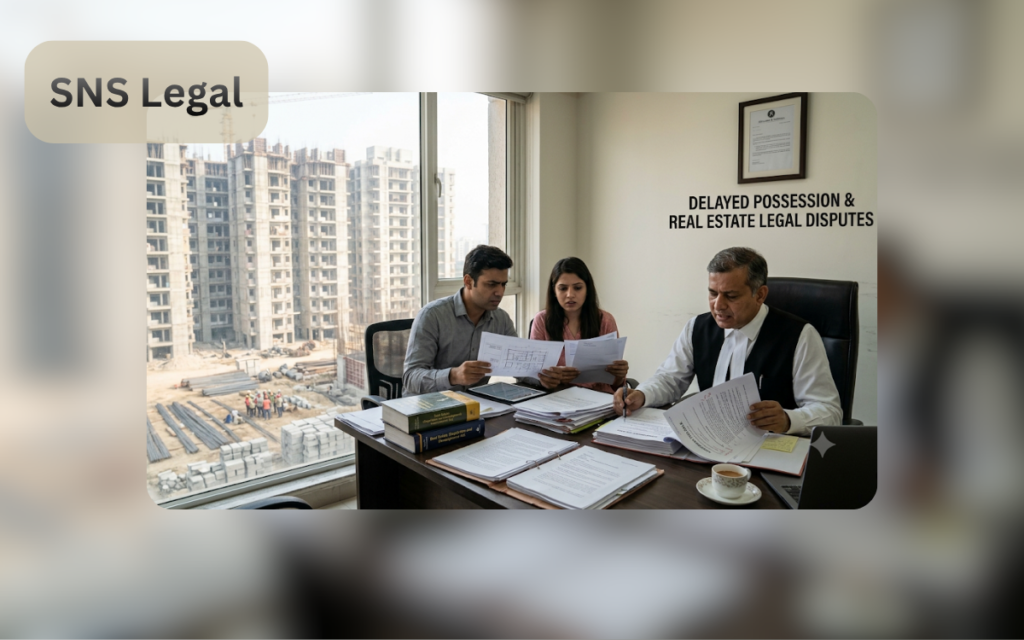

For homebuyers, property investors, and commercial tenants, a delayed possession or a stuck property deal is not merely an inconvenience; it is a severe financial and emotional crisis. Capital is locked, EMIs continue to accrue, and alternative housing plans are thrown into disarray. For real estate developers, these situations present significant reputational and statutory liability risks.
t SNS Legal, we frequently advise clients navigating complex real estate legal disputes. The legal landscape in India has evolved significantly over the past decade, shifting the balance of power toward greater transparency and buyer protection. However, knowing your rights is only half the battle; executing the correct legal strategy is what ultimately secures your investment.
This guide provides a precise, actionable breakdown of your legal remedies under the Real Estate (Regulation and Development) Act, 2016 (RERA), the Consumer Protection Act, 2019, and the Insolvency and Bankruptcy Code (IBC), 2016.
The Foundational Right: Section 18 of the RERA Act
The cornerstone of homebuyer protection in India is Section 18 of the RERA Act, 2016. If a promoter fails to complete or is unable to give possession of an apartment, plot, or building by the date specified in the agreement for sale, the allottee has two distinct, legally enforceable options:
- Withdraw from the Project: The buyer is entitled to a full refund of the amount paid, along with interest at the prescribed RERA rate (typically the State Bank of India’s Marginal Cost of Lending Rate plus 2%), and compensation for any losses suffered.
- Continue with the Project: The buyer may choose to wait for possession. In this scenario, the promoter is liable to pay monthly compensation for every month of delay, until the handover of physical possession.
Landmark Precedent: In Newtech Promoters and Developers Pvt. Ltd. v. State of U.P. (2021), the Supreme Court of India unequivocally held that RERA has retrospective application. If a project was delayed even before the enactment of RERA, and possession remains pending, homebuyers are fully entitled to invoke Section 18 for compensation and refunds.
The Forum Dilemma: RERA vs. Consumer Court vs. IBC
One of the most common questions we encounter is: “Which forum should I approach?” Historically, builders argued that approaching a Consumer Court was barred if a project was registered under RERA. The Supreme Court shattered this defense.
In M/s Imperia Structures Ltd. v. Anil Patni (2020), the Supreme Court ruled that the remedies under RERA, the Consumer Protection Act, and civil courts are concurrent. A homebuyer can choose the forum they deem most appropriate. Furthermore, in Pioneer Urban Land and Infrastructure Ltd. v. Union of India (2019), the Court affirmed that homebuyers are classified as “financial creditors” under the IBC, allowing them to initiate Corporate Insolvency Resolution Process (CIRP) proceedings against defaulting builders.
| Legal Forum | Best Used For | Pros | Cons |
|---|---|---|---|
| RERA Authority | Delayed possession, refund with interest, project misrepresentation. | Specialized, faster statutory timelines, strict penalties on builders. | Varies by state; some state authorities face administrative backlogs. |
| Consumer Court (NCDRC/State/District) | Deficiency in service, unfair trade practices, compensation for mental agony. | Well-established procedural framework, no court fee in many states. | Can be time-consuming; appeals can delay final realization. |
| IBC (NCLT) | Builder is genuinely insolvent, funds are siphoned, or project is completely stalled. | Powerful tool to force promoter accountability; overrides other civil proceedings. | Lengthy process; recovery is not guaranteed and depends on the resolution plan. |
The “Force Majeure” Trap: How Builders Avoid Liability
A frequent defense raised by developers in real estate legal disputes India wide is “Force Majeure” (Section 2(g) of RERA), citing events beyond their control, such as pandemics, extreme weather, or sudden regulatory changes.
How to counter this: Courts and RERA authorities strictly interpret Force Majeure. It does not cover poor financial planning, labor shortages due to mismanagement, or delays in obtaining approvals that the builder should have secured prior to launching the project. If a builder invokes Force Majeure, they must prove a direct, unbroken causal link between the extraordinary event and the specific delay. Blanket extensions are routinely struck down by the Delhi High Court and appellate tribunals.
Pre-Litigation Checklist: Protecting Your Position
Before engaging a RERA lawyer for delayed possession, ensure your documentation is impeccable. A strong legal claim is built on meticulous records.
- Verify RERA Registration: Confirm the project’s valid registration number on the respective state RERA portal. Check the “Litigation” tab for existing cases against the promoter.
- Conduct Property Title Due Diligence: If the dispute involves secondary sales or stuck commercial deals, engage a legal expert to conduct thorough property title due diligence. Ensure there are no prior mortgages, lis pendens (pending litigation) notices, or attachment orders by revenue authorities.
- Compile the Paper Trail: Gather the Allotment Letter, Builder-Buyer Agreement, all payment receipts, bank loan sanction letters, and a chronological log of all email/WhatsApp communications with the builder’s representatives.
- Issue a Formal Legal Notice: Before filing a formal complaint, a precisely drafted legal notice under Section 18 of RERA or Section 2(1)(o) of the Consumer Protection Act serves as a strong catalyst. It demonstrates your seriousness and often prompts builders to offer a settlement to avoid statutory penalties.
Common Legal Mistakes Homebuyers Make
- Signing Unilateral Extension Agreements: Builders often pressure buyers to sign “supplementary agreements” extending the possession date by 12–24 months, sometimes offering minor waivers on maintenance fees. Risk: Signing this legally waives your right to claim compensation for the original delay period. Prevention: Never sign an extension without prior legal review by an advocate.
- Stopping EMI Payments: In frustration, some homebuyers unilaterally stop paying bank EMIs. Risk: This severely damages your CIBIL score and gives the bank the right to initiate SARFAESI proceedings against you, regardless of the builder’s default. Prevention: Continue EMI payments while legally pursuing the builder for compensation.
- Delaying Action: Statutory limitation periods apply. While RERA is relatively flexible, delaying action allows the builder’s financial position to deteriorate, making eventual recovery of funds nearly impossible.
Key Legal Takeaways / Quick Summary
- Section 18 RERA is Your Shield: You are legally entitled to a full refund with interest or monthly compensation for every month of delay.
- Concurrent Jurisdiction: The Imperia Structures judgment confirms you can choose between RERA, Consumer Courts, or Civil Courts based on strategic advantage.
- Force Majeure is Not a Blanket Excuse: Builders must prove a direct causal link between an unforeseeable event and the delay; mismanagement does not qualify.
- Documentation is Critical: Maintain a rigorous paper trail of all communications, payments, and agreements.
- Beware of Extension Traps: Do not sign supplementary delay agreements without legal counsel, as they may waive your statutory rights.
Frequently Asked Questions
Q1: Can I get a refund if the builder delays possession beyond the agreed date?
Yes. Under Section 18 of the RERA Act, 2016, if the promoter fails to give possession by the agreed date, the allottee is entitled to withdraw from the project and receive a full refund of the amount paid, along with interest and compensation for losses.
Q2: Can a homebuyer approach both RERA and the Consumer Court for the same dispute?
While the remedies are concurrent, you cannot pursue the exact same cause of action in two forums simultaneously to avoid double recovery. However, if one forum dismisses your case on technical grounds, you may approach the other. Strategic selection of the most appropriate forum is crucial.
Q3: What happens if the real estate developer goes bankrupt?
Under the Pioneer Urban (2019) Supreme Court ruling, homebuyers are recognized as “financial creditors” under the Insolvency and Bankruptcy Code (IBC), 2016. You can file an application before the National Company Law Tribunal (NCLT) to initiate insolvency proceedings against the defaulting developer.
Q4: Is property title due diligence necessary if the project is RERA-registered?
Yes. While RERA registration mandates that the promoter declares clear title, it does not guarantee it. Independent property title due diligence is essential to uncover hidden encumbrances, prior mortgages, or municipal disputes that could jeopardize your ownership rights post-possession.
Conclusion
Legal Insight: Proactive Enforcement is Your Best Defense
In the realm of real estate, time is not just money; it is leverage. The longer a possession is delayed, the higher the risk of the developer’s financial insolvency or the dissipation of project funds. Relying on verbal assurances from sales teams is a perilous strategy. The most effective way to resolve stuck property deals is through swift, legally sound action. By understanding your statutory rights under RERA and deploying the correct legal forum, you transition from a passive victim of delay to an empowered stakeholder demanding accountability.
Secure Your Property Investment with SNS Legal
Do not let a delayed possession or a disputed title erode your hard-earned investment. Whether you need a robust legal notice, representation before the RERA Authority, or strategic advice on navigating the IBC, our specialized real estate litigation team is here to protect your interests.
📞 Contact SNS Legal Today: Schedule a confidential, 30-minute strategic consultation to evaluate your case and determine the most effective legal remedy.
🌐 Visit: https://snslegal.in/