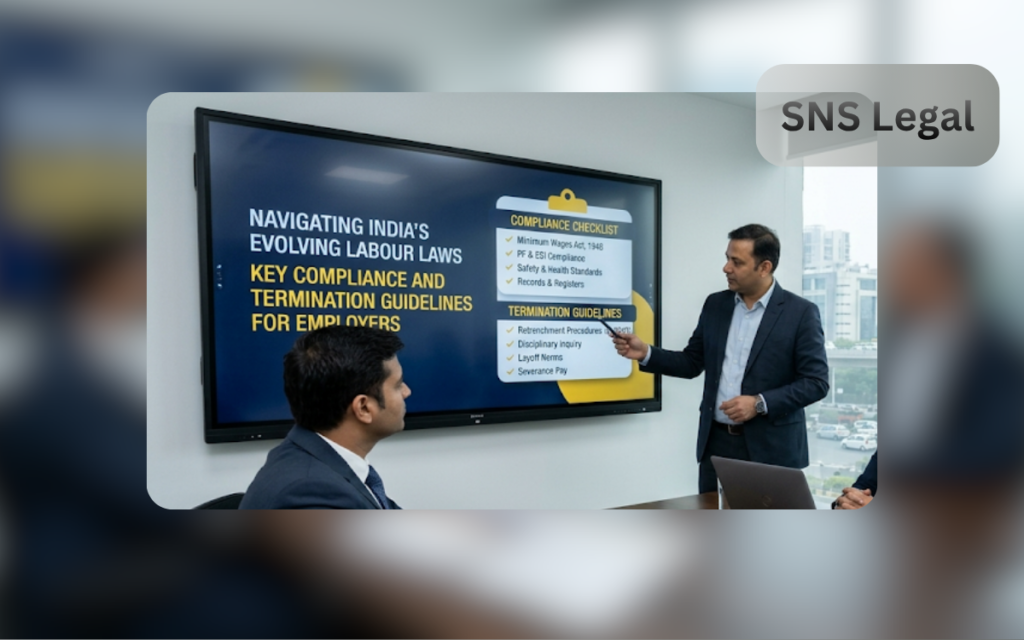

In India’s dynamic corporate landscape, employment termination is one of the most legally fraught actions an organization can undertake. For multinational corporations setting up in India, startup founders, and HR directors, the margin for error is razor-thin. A procedurally flawed termination can rapidly escalate into protracted litigation before Labour Courts, Industrial Tribunals, or Civil Courts, resulting in significant financial liability and reputational damage.
At SNS Legal, we advise that robust India labour law compliance and termination guidelines must be embedded into your organizational DNA, not treated as an afterthought during a crisis. This guide provides a strategic, legally sound framework for navigating employee separations while strictly adhering to statutory mandates and judicial precedents.
The Foundational Legal Framework
Employment termination in India is not governed by a single, monolithic statute. It is a complex interplay of central and state laws, including:
• The Industrial Disputes Act, 1947 (IDA): The cornerstone legislation governing retrenchment, lay-offs, and closure, particularly for “workmen.”
• State-Specific Shops and Establishments Acts: (e.g., The Delhi Shops and Establishments Act, 1954) which dictate notice periods, working hours, and termination procedures for non-factory establishments.
•The Sexual Harassment of Women at Workplace (Prevention, Prohibition and Redressal) Act, 2013 (POSH): Mandates strict procedural fairness if termination is linked to, or occurs during, a POSH inquiry.
• The Payment of Gratuity Act, 1972: Governs the forfeiture or payment of gratuity upon termination.
The Critical Distinction: “Workman” vs. “Non-Workman”
The most common and costly mistake employers make is applying a blanket termination policy across all employee levels. Indian labour law draws a sharp, legally significant distinction between a “workman” and a “non-workman” (managerial, administrative, or supervisory staff drawing wages above a specified threshold).
• For “Workmen” (Section 2(s) of the IDA): Employees primarily engaged in manual, unskilled, skilled, technical, operational, or clerical work. Terminating a workman for reasons other than disciplinary punishment (i.e., retrenchment) mandates strict compliance with Section 25F of the IDA.
• For “Non-Workmen” (Senior Management, Executives, CHROs): Their employment is primarily governed by the terms of their Employment Agreement and the principles of contract law under the Indian Contract Act, 1872, and the Specific Relief Act, 1963.
Landmark Precedent: In Amazon Seller Services Pvt. Ltd. v. Amitesh Aggarwal (2021), the Delhi High Court reiterated that senior executives and managerial personnel do not qualify as “workmen” under the IDA. Their termination is governed by the specific termination clauses in their employment contracts, and they cannot claim reinstatement under labour statutes.
Step-by-Step Termination Compliance Checklist
To mitigate the risk of wrongful termination lawsuits, employers must follow a rigorous, documented process.
Phase 1: Pre-Termination Due Diligence
• Review the Employment Contract: Verify the notice period, termination for cause vs. without cause clauses, and severance entitlements.
• Audit the Employee’s Classification: Confirm whether the employee legally qualifies as a “workman” or “non-workman” based on their primary duties, not just their job title.
• Check for Protected Status: Ensure the employee is not pregnant (violating the Maternity Benefit Act, 1961), a protected trade union member, or currently involved in a POSH or whistleblower inquiry.
Phase 2: Execution of Termination (Retrenchment under Section 25F, IDA)
If the employee is a “workman” and the termination is due to redundancy or restructuring, the employer must fulfill three concurrent conditions:
1. One Month’s Notice: Provide one month’s written notice indicating the reasons for retrenchment, OR pay one month’s wages in lieu of such notice.
2. Retrenchment Compensation: Pay compensation equivalent to 15 days’ average pay for every completed year of continuous service (or any part thereof in excess of six months).
3. Statutory Notice to Government: For establishments with 100+ workmen, prior permission from the appropriate government is required under Section 25N of the IDA.
Judicial Warning: The Supreme Court in J.K. Synthetics Ltd. v. K.P. Agrawal (2007) held that the conditions of Section 25F are mandatory, not directory. Substantial compliance is insufficient; failure to strictly adhere renders the termination void ab initio.
Phase 3: Post-Termination Formalities
• Full and Final (F&F) Settlement: Process all pending dues, including encashment of earned leave, within 48 hours of termination (as mandated by various State Shops and Establishments rules).
• Gratuity Payment: If the employee has completed 5 years of continuous service, process gratuity within 30 days of it becoming payable. Forfeiture is only permissible under Section 4(6) of the Gratuity Act for specific acts of moral turpitude or violent behavior, and requires strict evidentiary backing.
• Issuance of Experience/Relieving Letter: Provide a neutral, factual relieving letter to avoid claims of defamation or tortious interference with future employment.
Navigating the Horizon: The New Labour Codes
While the implementation of the four new Labour Codes (Code on Wages, Industrial Relations Code, Occupational Safety, Health and Working Conditions Code, and Code on Social Security) has been delayed, employers must prepare for their imminent enforcement.
Key shifts impacting termination and compliance include:
• Fixed-Term Employment (FTE): The IR Code formalizes FTE, granting such employees all statutory benefits (including gratuity, regardless of the 5-year threshold) on a pro-rata basis, with termination occurring automatically at the contract’s expiry without attracting retrenchment compensation.
• Retrenchment Threshold: The requirement for government permission for retrenchment, lay-off, or closure will apply to establishments with 300 or more workers (increased from 100), offering mid-sized businesses greater operational flexibility.
Common Legal Pitfalls and How to Avoid Them
- Misclassifying Employees as “Independent Consultants”: Drafting a “Consultancy Agreement” does not override the reality of the working relationship. If the company controls the hours, tools, and methods of work, courts will deem it an employer-employee relationship, attracting full statutory liability (Dharangadhra Chemical Works Ltd. v. State of Saurashtra).
- Vague “Termination for Cause” Clauses: Terminating an employee for “misconduct” without conducting a formal, principles-of-natural-justice-compliant domestic inquiry is a primary trigger for wrongful termination suits.
- Ignoring POSH Protocols: Terminating an employee who has recently filed a POSH complaint, even for legitimate performance reasons, can be construed as victimization or retaliation under Section 19 of the POSH Act
Key Legal Takeaways / Quick Summary
- Classification is Key: Always determine if an employee is a “workman” under Section 2(s) of the IDA before initiating termination.
- Section 25F is Mandatory: Retrenchment of a workman without notice, compensation, and proper procedure is legally void.
- Senior Management is Contractual: Termination of executives is governed by the employment contract and civil law, not the IDA.
- Documentation is Defense: Maintain meticulous records of performance reviews, warnings, and domestic inquiries to justify “termination for cause.”
- Future-Proofing: Align current HR policies with the forthcoming provisions of the new Labour Codes, particularly regarding Fixed-Term Employment.
Frequently Asked Questions
Q1: Can an employer terminate an employee without giving a reason in India?
For “non-workmen” (senior management), yes, if the employment contract explicitly allows “termination without cause” upon serving the stipulated notice period or paying in lieu thereof. For “workmen,” retrenchment must be for a valid reason (e.g., redundancy), and the reasons must be stated in the notice as per Section 25F of the IDA.
Q2: What is the statutory retrenchment compensation in India?
Under Section 25F(b) of the Industrial Disputes Act, 1947, a workman is entitled to compensation equivalent to 15 days’ average pay for every completed year of continuous service, or any part thereof in excess of six months.
Q3: Can a company withhold gratuity if an employee is terminated for poor performance?
No. Under the Payment of Gratuity Act, 1972, gratuity can only be forfeited if the employee’s services are terminated for an act constituting an offense involving moral turpitude, or for willful omission/negligence causing damage to the employer, and only to the extent of the damage. Poor performance does not qualify.
Q4: How does the POSH Act impact employee termination?
If a termination is linked to a POSH complaint, the employer must ensure the Internal Committee (IC) has completed its inquiry. Terminating a complainant, respondent, or witness during an active inquiry without overwhelming, documented, unrelated cause can be deemed retaliation, attracting penalties under Section 19 of the POSH Act.
Conclusion
Legal Insight: Compliance as a Strategic Business Enabler
In the modern corporate environment, rigorous labour law compliance is not merely a defensive legal tactic; it is a strategic business enabler. Organizations that institutionalize fair, transparent, and legally sound termination protocols experience lower employee turnover, higher morale, and significantly reduced litigation costs. Navigating the intersection of the Industrial Disputes Act, state regulations, and contractual obligations requires precision. When in doubt, the most cost-effective decision is to seek expert legal counsel before the termination letter is issued, not after the legal notice arrives.
Secure Your Organization’s Employment Practices with SNS Legal
Do not leave your company’s most critical asset, its human capital, exposed to regulatory or litigation risks. Whether you are drafting robust employment contracts, restructuring your workforce, or defending against a wrongful termination claim, the expert employment law team at SNS Legal is here to guide you.
📞 Contact SNS Legal Today: Schedule a confidential, strategic consultation with our labour and employment law specialists to audit your HR policies and termination protocols.
🌐 Visit: https://snslegal.in/