
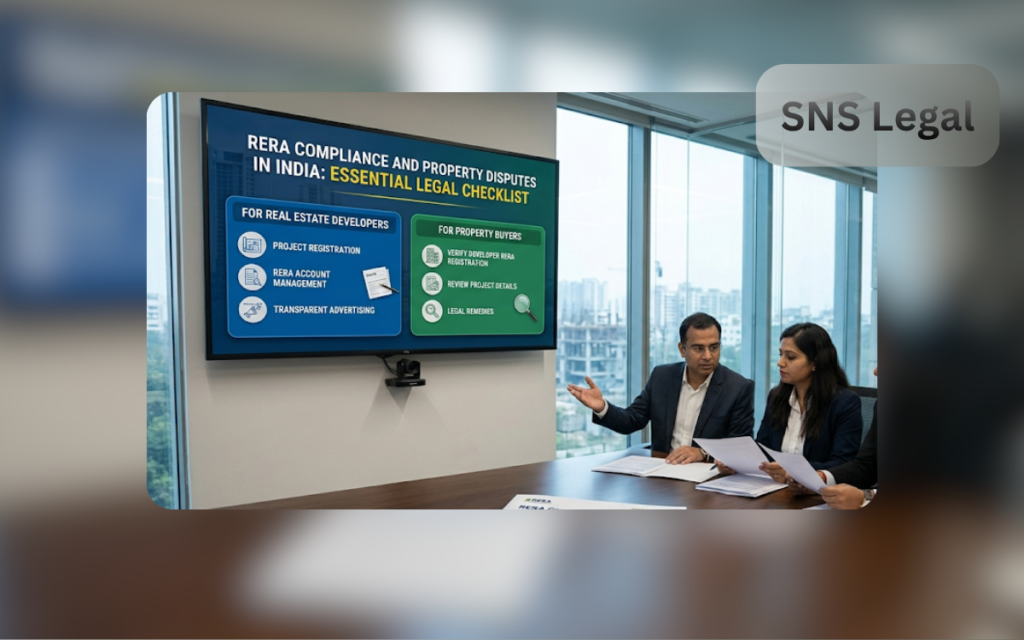

The enactment of the Real Estate (Regulation and Development) Act, 2016 (RERA) fundamentally transformed India’s real estate landscape. For over a decade, it has served as the primary shield for homebuyers and the definitive compliance framework for developers, builders, and contractors. However, as the market evolves, so do the complexities of property disputes, delayed possessions, and regulatory scrutiny.
At SNS Legal, we advise pan-India real estate stakeholders that proactive compliance is significantly more cost-effective than reactive litigation. Whether you are a developer launching a new project in the National Capital Region (NCR) or a buyer securing your life’s investment, understanding the statutory nuances of RERA is non-negotiable.
The Core Statutory Framework: What You Must Know
RERA is not merely a registration formality; it is a comprehensive statutory regime. Key provisions that frequently become the epicenter of property disputes include:
• Section 3 (Mandatory Registration): Applies to all commercial and residential projects where the land exceeds 500 square meters or includes more than 8 apartments. Failure to register attracts penalties up to 10% of the project’s estimated cost, or imprisonment up to three years, or both.
• Section 12 (True and Accurate Advertisement): Developers are legally bound to ensure that all advertisements and prospectuses strictly match the details registered on the state RERA portal. Any deviation is treated as a misleading practice.
• Section 18 (Return of Amount and Compensation): If a promoter fails to complete or is unable to give possession by the date specified in the agreement, the allottee is entitled to a full refund of the amount paid, along with interest and compensation.
• Section 31 & 43 (Complaints and Appellate Tribunal): Establishes the mechanism for filing complaints before the State Real Estate Regulatory Authority and appeals before the Real Estate Appellate Tribunal (REAT).
Landmark Precedents Shaping Property Disputes
Indian courts have consistently interpreted RERA in a manner that balances consumer protection with practical industry realities. Two Supreme Court judgments are particularly critical for stakeholders to understand:
1. Newtech Promoters and Developers Pvt. Ltd. v. State of U.P. (2021): The Supreme Court unequivocally held that RERA has a retrospective application regarding ongoing projects. Homebuyers can approach the RERA authority for delays that occurred even before the Act’s enactment, provided the possession was delayed beyond the agreed timeline.
2. Pioneer Urban Land and Infrastructure Ltd. v. Union of India (2019): The Court upheld the constitutional validity of RERA and clarified that homebuyers are classified as “financial creditors” under the Insolvency and Bankruptcy Code (IBC), 2016. This creates a complex but vital intersection between RERA remedies and corporate insolvency proceedings.
Essential Legal Checklist for Real Estate Developers & Builders
To mitigate liability and ensure seamless project execution, developers must institutionalize the following compliance protocols:
• Pre-Launch Due Diligence: Ensure all land titles are clear, encumbrance certificates are updated, and necessary approvals (building plan, environmental clearance, fire NOC) are secured before applying for RERA registration.
• Escrow Account Discipline: Maintain the mandatory 70% of project receipts in a separate scheduled bank account (Section 4(2)(l)(D)). Withdrawals must strictly align with the proportion of project completion certified by an engineer, architect, and CA.
• Transparent Allotment Agreements: Use the model agreement prescribed by the state RERA authority. Avoid one-sided “force majeure” clauses that attempt to blanketly excuse delays caused by poor planning or financial mismanagement.
• Quarterly Compliance Updates: Upload project progress, financial statements, and any changes in sanctioned plans to the state RERA portal within the stipulated timelines to avoid late fees and deregistration risks.
Essential Legal Checklist for Homebuyers & Investors
- RERA Registration Verification: Do not rely on marketing brochures. Independently verify the project’s RERA registration number on the official state portal (e.g., DLRERA for Delhi, MahaRERA for Maharashtra). Check the “Litigation” tab for any pending cases against the promoter.
- Carpet Area Calculation: Ensure the agreement explicitly defines the “carpet area” as per Section 2(k) of RERA (net usable floor area, excluding external walls, service shafts, and exclusive balcony/verandah areas).
- Payment Plan Alignment: Refuse any demand for more than 10% of the property cost as an advance or application fee before a registered sale agreement is executed (Section 13).
- Documenting Communications: Maintain a written trail of all communications with the builder’s sales team, especially regarding promised amenities, possession dates, and payment schedules.
Navigating the Dispute Resolution Pathway
When disputes arise, a strategic, phased approach yields the best results:
1. Pre-Litigation Legal Notice: Draft a precise legal notice under Section 18 or Section 31, detailing the breach, the specific relief sought (refund, compensation, or possession), and a reasonable response window (typically 30 days).
2. Filing Before the RERA Authority: If unresolved, file a formal complaint. RERA proceedings are summary in nature, making them faster than traditional civil courts.
3. Appellate Escalation: If either party is aggrieved by the Authority’s order, an appeal can be filed before the REAT within 60 days, provided 30% of the penalty or disputed amount is deposited (Section 43(5)).
4. Parallel IBC Action: In cases of severe developer insolvency, buyers may consider initiating Corporate Insolvency Resolution Process (CIRP) proceedings, though recent amendments require a higher threshold of default and allottee consensus.
Key Legal Takeaways / Quick Summary
- Mandatory Registration: Projects >500 sq. m or 8 apartments must be RERA-registered.
- Escrow Mandate: 70% of buyer funds must be parked in a dedicated escrow account.
- Retrospective Relief: Buyers can claim compensation for delays predating RERA if possession is still pending (Newtech Promoters ruling).
- Dual Remedies: Homebuyers are financial creditors under IBC, allowing parallel avenues for recovery in cases of builder default.
- Documentation is Defense: Both parties must rely on the state-approved model agreement, not informal brochures or verbal promises.
Frequently Asked Questions
Q1: Can a homebuyer file a RERA complaint for a project delayed before 2016?
Yes. The Supreme Court in Newtech Promoters (2021) ruled that RERA applies retrospectively to ongoing projects. If possession is delayed beyond the agreed date, buyers can seek compensation under RERA regardless of when the agreement was signed.
Q2: What is the penalty for a builder not registering a project under RERA?
Under Section 59 of the Act, a promoter may be penalized up to 10% of the estimated project cost. Continued non-compliance can lead to imprisonment for up to three years, or both.
Q3: Can a buyer approach both RERA and the Consumer Court (NCDRC) simultaneously?
No. While the remedy is concurrent, you cannot pursue the same cause of action in two forums simultaneously. You must choose one. However, if one forum dismisses the case on technical grounds, you may approach the other, subject to specific legal advice.
Q4: Does “Force Majeure” excuse all construction delays?
No. Force majeure (Section 2(g)) only covers truly unforeseeable, external events (e.g., natural disasters, pandemics, or sudden changes in law). Delays due to labor shortages, funding issues, or poor project management do not qualify.
Conclusion: The Strategic Advantage of Proactive Legal Counsel
Legal Insight: Compliance as a Competitive Edge
In today’s hyper-transparent real estate market, RERA compliance is no longer just a regulatory hurdle; it is a powerful marketing asset. Developers who maintain impeccable RERA records build institutional trust, facilitating faster sales and smoother financing. Conversely, for buyers, rigorous due diligence is the only reliable defense against capital erosion. Navigating this landscape requires more than just reading the statute; it demands strategic foresight and precise execution.
Secure Your Real Estate Interests
Partner with SNS Legal for Strategic Real Estate Counsel
Whether you are a developer seeking to audit your project’s RERA compliance or a homebuyer facing unjustified possession delays, do not navigate the legal complexities alone. Our specialized real estate litigation and advisory team at SNS Legal is equipped to protect your interests across the Supreme Court, High Courts, and State RERA Authorities.
📞 Contact SNS Legal Today: Schedule a confidential, 30-minute strategic consultation to evaluate your property dispute or compliance requirements.
🌐 Visit: https://snslegal.in/